
Justice
A Mississippi Boycott May Be the Path to Justice in the Nolan Wells Case
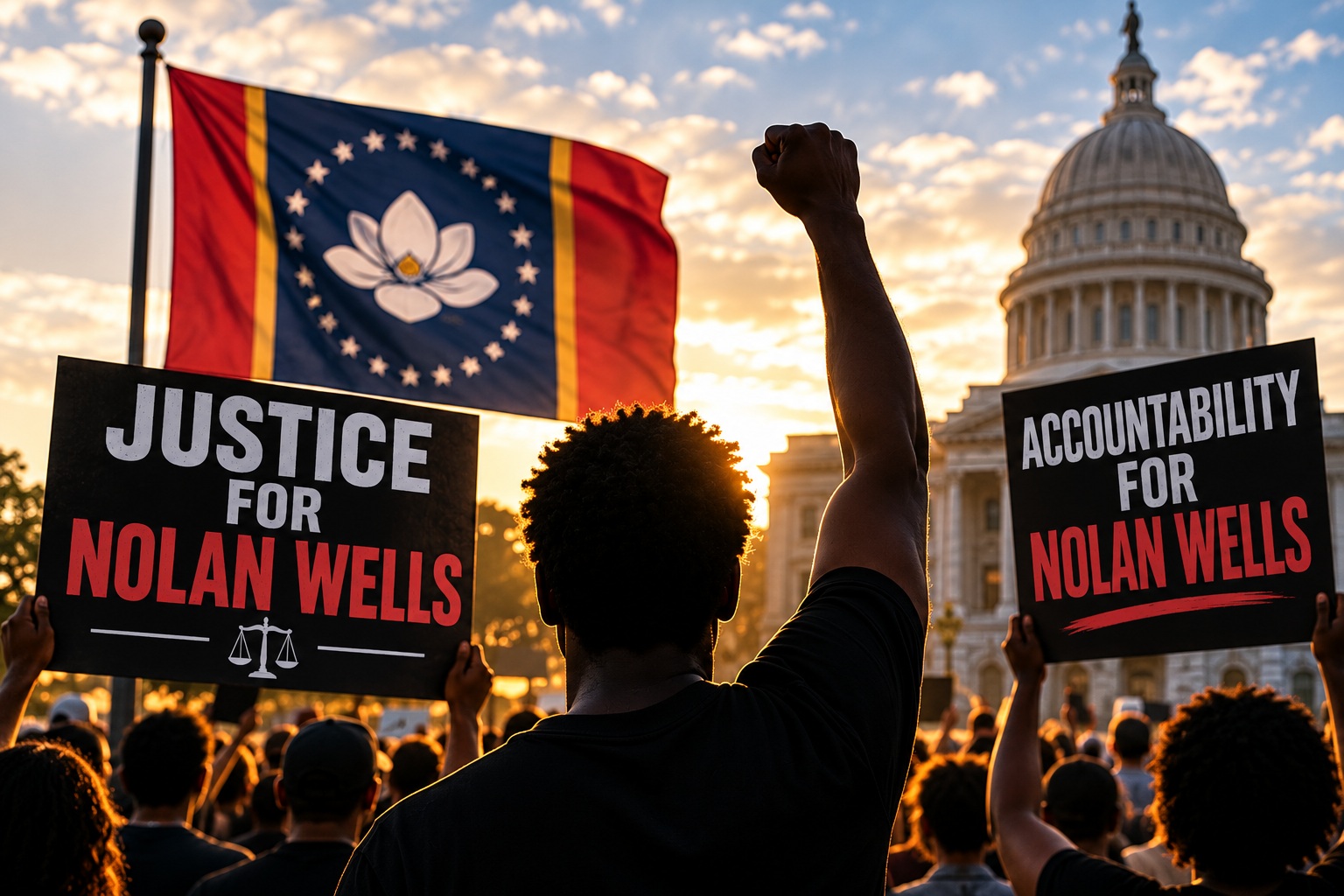
Justice for Nolan Wells Is Justice for Everyone:
Why a Mississippi Travel Boycott Could Make a Difference
When the justice system fails one family, the consequences reach far beyond that family. Economic accountability offers communities another way to demand answers.
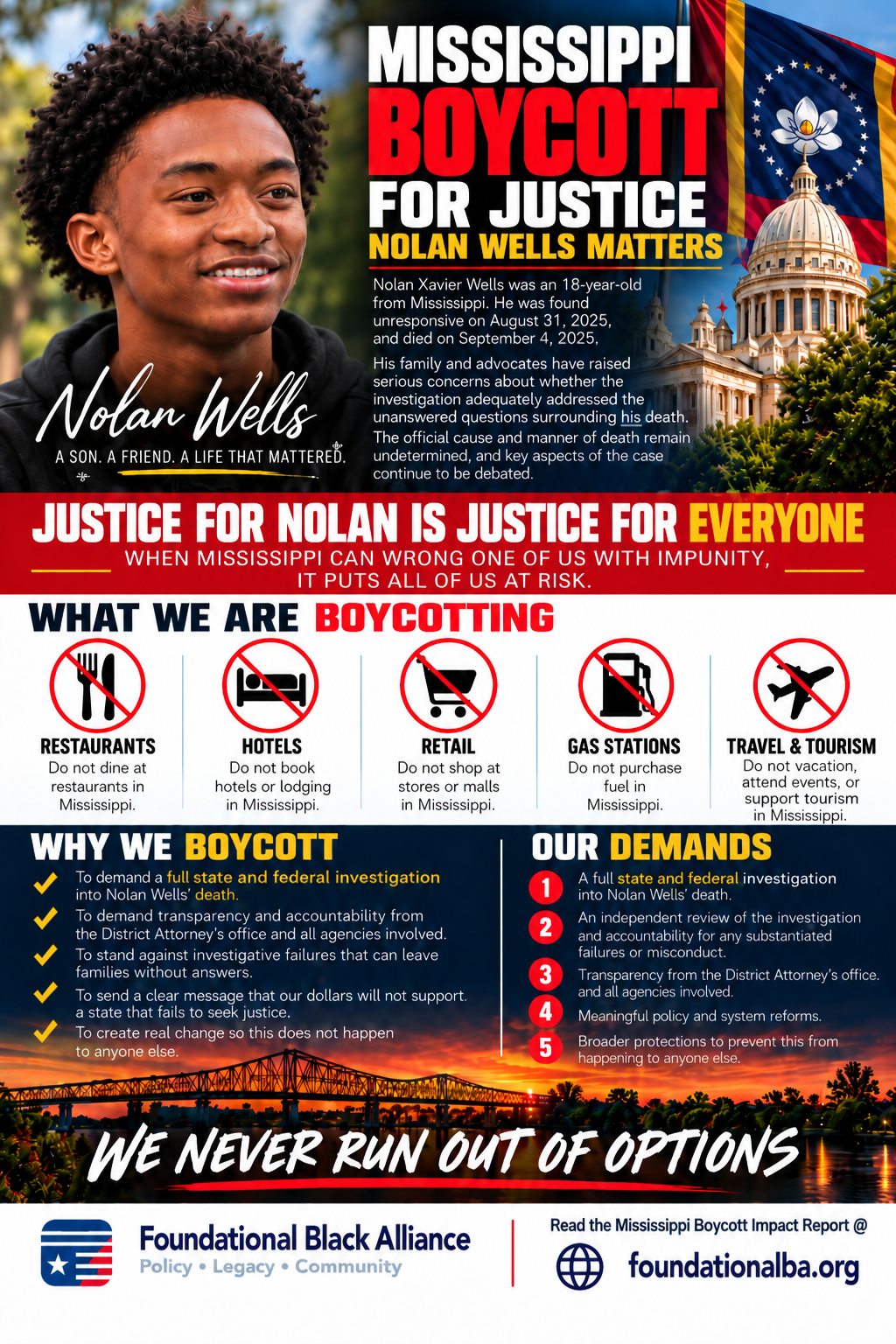
The death of 20-year-old Nolan Xavier Wells has raised serious questions about the handling of his case in Mississippi. His family and supporters are seeking answers about the investigation, the actions of the District Attorney's office, and whether potential suspects received greater consideration than the pursuit of justice.
Nolan was an only child. For his family, this is not simply a matter of public policy or institutional accountability. It is the loss of a beloved son whose life mattered and whose death deserves a thorough investigation.
The Foundational Black Alliance believes that justice for Nolan Wells is justice for everyone who has been denied answers, accountability, or fair treatment by Mississippi's justice system.
The issue extends beyond one case. When authorities fail to investigate a death adequately, public confidence in the justice system suffers. Every family deserves to know that its concerns will be taken seriously, regardless of race, income, or political influence.
Why Economic Pressure Matters
For generations, communities have used peaceful economic boycotts to demand justice when traditional channels failed to produce meaningful change.
The Montgomery bus boycott demonstrated the power of sustained collective action. Mississippi itself has a significant place in boycott history through the Claiborne County boycott, whose nonviolent activities received constitutional protection in the landmark Supreme Court decision NAACP v. Claiborne Hardware Co.
Today, the same principle remains relevant: communities have the power to decide where their money goes.
A travel boycott offers individuals, families, churches, professional organizations, and community groups a peaceful way to express dissatisfaction with government accountability.
But could such a boycott actually affect Mississippi's economy?
The Foundational Black Alliance examined that question using official tourism statistics and visitor-demographic research.
The Economic Power of Black American Travelers
According to Mississippi's 2025 tourism figures, the state welcomed approximately 45.5 million visitors, generating $12.4 billion in visitor spending.
Black American travelers represent an important part of that economy.
The Foundational Black Alliance's Mississippi Travel Boycott Impact Report estimates that Black travelers account for approximately 22.5% of Mississippi's domestic travel spending, using available visitor-demographic data and spending patterns.
Applied to the state's 2025 tourism figures, that represents an estimated $2.79 billion in annual visitor spending associated with Black travel.
What Could a 50% Reduction in Travel Mean?
If Black American travel to Mississippi declined by 50% for an entire year, the report models the following potential economic effects:
These are modeled scenarios, not guaranteed economic losses. Actual results would depend on participation, duration, and replacement travel.
The message is straightforward: Black American travelers are not economically insignificant, and their decisions about where to spend money deserve attention.
Read the Complete Economic Impact Report
Explore the data, participation scenarios, tourism industries, and economic methodology behind these findings.n
How Long Would a Boycott Need to Last?
The report also considers an important question: How long would a travel boycott need to continue before its economic effects became noticeable?
A short boycott can generate publicity, but sustained participation may be necessary to produce a measurable statewide impact.
The analysis identifies approximately 90 days as a reasonable minimum period for evaluating economic effects, while six months could produce a substantially clearer signal.
A full year would provide the strongest basis for comparing changes across Mississippi's tourism economy.
The report also examines seasonal travel patterns, tourism-dependent communities, and the industries most exposed to reduced visitor spending.
What Would Justice and Accountability Look Like?
The Foundational Black Alliance's call for accountability is grounded in the belief that no family should be left without meaningful answers when a loved one dies under troubling circumstances.
In Nolan Wells' case, the Alliance calls for:
- A thorough state and federal investigation into the circumstances of his death and the handling of the original investigation.
- A transparent examination of the District Attorney's office and the decisions made throughout the case.
- Accountability wherever investigative failures, misconduct, or obstruction are established.
- Meaningful reforms to prevent other families from experiencing similar failures.
These demands are not about presuming anyone's guilt. They are about ensuring that the evidence is properly examined, the relevant decisions are scrutinized, and the public can have confidence in the outcome.
Justice for One Family Can Help Protect Every Family
The importance of Nolan Wells' case reaches beyond Mississippi.
An inadequate investigation does more than deny one family answers. It raises concerns about whether other families might face similar treatment.
That is why accountability matters.
When public officials are required to explain their decisions, investigations are subjected to appropriate scrutiny, and institutions are held to consistent standards, the benefits extend to everyone.
A successful demand for accountability in Nolan's case could help establish expectations for transparency and fair treatment in future cases.
The goal is not simply to draw attention to one tragedy. It is to encourage a justice system in which every life receives the consideration it deserves.
Making a Way
The Foundational Black Alliance believes that communities do not have to remain powerless when institutions fail to respond.
Peaceful economic action, public advocacy, legal remedies, civic participation, and organized community engagement are all tools available to people seeking accountability.
The Mississippi Travel Boycott Impact Report demonstrates that consumer spending is one potential source of meaningful economic influence.
A boycott alone cannot guarantee justice. But coordinated, sustained action can increase public attention, encourage institutional responses, and reinforce the demand for transparency.
Justice for Nolan Wells Is Justice for Everyone.
Because when one family is denied a fair and thorough investigation, every community has reason to demand better.
And when people organize around a shared commitment to accountability, they demonstrate a simple truth:
We Never Run Out of Options.
Read the Mississippi Boycott Report
Explore the proposed strategy, history, economic considerations, and steps for supporters.
References and further reading
- Reuters (October 6, 2026): Wells family seeks federal investigation following grand jury decision
- The Guardian (September 22, 2026): Grand jury decision and findings
- The Guardian (October 9, 2026): Student calls for transparency and justice
- National Park Service: History of the Montgomery Bus Boycott